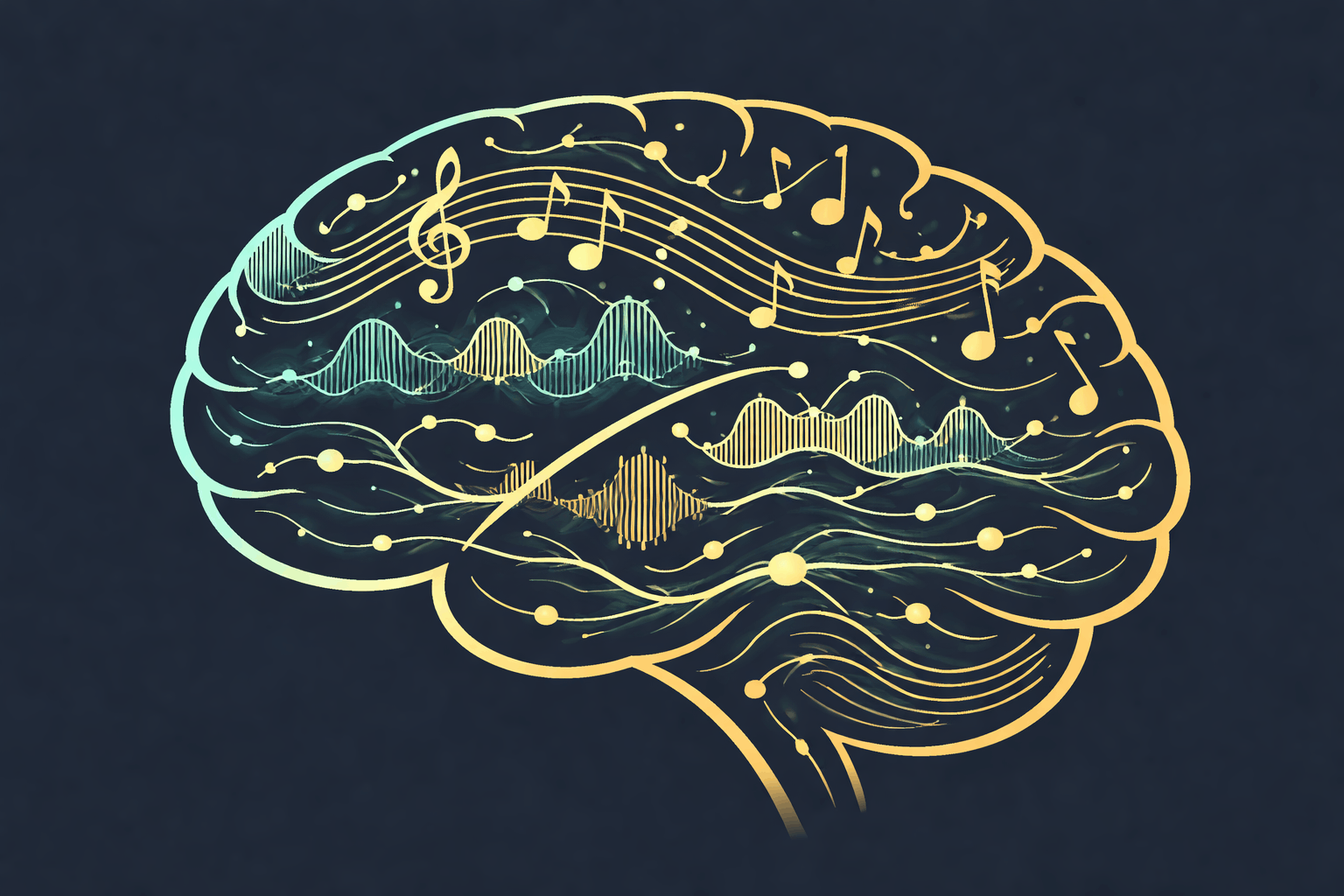
If It Works in Music, It Works Everywhere
Neuroscience has identified performed music as one of the most cognitively demanding activities the human brain can undertake. The principles that produce mastery here transfer to every discipline. Here’s the research — and why I now coach non-musicians.
Why the Most Demanding Cognitive Activity on Earth Produces Principles That Transfer to Every Discipline
I didn't set out to coach non-musicians. I set out to understand why music saved my life when nothing else could — and what I found in the research changed how I think about human performance entirely.
Here's the short version: neuroscience has identified performed music as one of the most cognitively demanding activities the human brain can undertake. Not one of the most demanding artistic activities. One of the most demanding activities, period. And the principles that produce mastery in this extraordinarily demanding context don't just apply to other fields — they apply more effectively, because they were forged in a harder environment than almost anything else you'll encounter.
Let me show you what I mean.
What Your Brain Actually Does When You Play Music
In 2007, Robert Zatorre and his colleagues at McGill University published a landmark paper in Nature Reviews Neuroscience that changed the conversation about music and cognition. Their finding: "Music performance is both a natural human activity, present in all societies, and one of the most complex and demanding cognitive challenges that the human mind can undertake. Unlike most other sensory-motor activities, music performance requires precise timing of several hierarchically organized actions, as well as precise control over pitch interval production" (Zatorre, Chen, & Penhune, 2007).
That paper has been cited thousands of times and its central claim has only gotten stronger with subsequent research. A 2025 pilot study published in Frontiers in Neuroscience confirmed that music perception and performance engage brain regions spanning executive function, language processing, socioemotional processing, multimodal integration, and motor planning and execution — simultaneously (Wu-Chung et al., 2025). No other single activity engages all of these systems at the same time.
Think about what that means. When you perform music, your brain is:
Reading notation (visual processing)
Translating symbols into physical movements (sensorimotor integration)
Timing those movements with millisecond precision (motor planning via cerebellum and basal ganglia)
Listening to what you just produced (auditory feedback)
Adjusting in real time based on what you hear (error correction via prefrontal cortex)
Anticipating what comes next in the score (predictive processing)
Coordinating with other musicians if in an ensemble (social cognition)
Managing the emotional content of the music (limbic system)
Doing all of this while managing performance anxiety (anterior cingulate cortex, amygdala)
No surgical procedure, no athletic performance, no business presentation requires all of these systems firing simultaneously at this level of precision. Surgery demands extraordinary motor precision and spatial reasoning, but the surgeon isn't also reading a score, managing emotional expression, and coordinating timing with fifteen other performers. An athlete processes sensory input and executes motor plans at high speed, but isn't simultaneously reading notation, producing aesthetic output, and engaging language processing centers.
Music is the only human activity that requires all of it at once.
Why Transfer Happens
Here's where it gets practical for non-musicians.
A 2025 editorial in Frontiers in Human Neuroscience reviewed the growing body of research on what scientists call "transfer effects" — the phenomenon where skills developed in one domain improve performance in another. The researchers found that music training produces transferable benefits across cognitive and motor skills, educational outcomes, and even second language acquisition (Delogu et al., 2025). A separate 2024 systematic review found that active music engagement enhances cognitive abilities including memory, verbal skills, and spatial-temporal skills (Stekić, 2024).
This isn't vague "music makes you smarter" territory. The mechanisms are specific and well-documented:
Motor precision transfers.
The fine motor control required to play an instrument with correct timing and dynamics builds neural pathways in the premotor cortex, cerebellum, and basal ganglia that serve any physical skill requiring precision and coordination. Research shows that musicians have increased functional connectivity in motor and multi-sensory areas even at rest — their brains are literally wired for more efficient movement (Luo et al., 2012).
Attentional control transfers.
Musical training develops the capacity to sustain focused attention on a complex, multi-layered task for extended periods. Formal musical instruction trains a set of attentional and executive functions that have both domain-specific and general consequences (Zatorre et al., 2007). If you can maintain focused attention through a complex musical passage, maintaining focus through a difficult negotiation or surgical procedure uses the same neural architecture.
Performance under pressure transfers.
This is the one I know from personal experience. At NAMM 2020, surrounded by 120,000 musicians, I played near my best — until I noticed some of the most accomplished drummers in the world watching me. My playing deteriorated measurably. That wasn't a confidence problem. That was my anterior cingulate cortex detecting a higher-competence observer, spiking cortisol, and pulling my prefrontal cortex into a fight with automated motor patterns my basal ganglia had spent decades refining. The neurological mechanism behind performance anxiety is identical whether you're on a stage, in a courtroom, in an operating room, or in a boardroom. If you learn to manage it in the context of live musical performance — one of the highest-stakes, most cognitively demanding performance environments that exists — you can manage it anywhere.
Emotional regulation transfers.
Music engages an intricate set of brain circuits including sensory-motor processing, cognitive, memory, and emotional components (Menon & Levitin, 2005). Training in musical expression builds your brain's capacity to process, regulate, and communicate emotional content — a skill that directly improves interpersonal communication, leadership presence, and stress management in any professional context.
Neuroplasticity compounds over time.
Studies show that musical training produces structural and functional changes in the brain, including increased grey and white matter density, a larger corpus callosum, and greater cortical remapping in areas related to performance (Schlaug et al., 1995). Research even found that playing music had a larger protective impact on cognitive function than other cognitive tasks like reading, writing, or performing crossword puzzles (Wan & Schlaug, 2010). The brain doesn't just perform better during music — it becomes a more capable instrument for everything else.
Why I Coach Non-Musicians
I spent fourteen years destroying my brain with drugs and alcohol. A 7-gram-a-day cocaine habit, 30-40 pills of ecstasy per week, a half gallon of whiskey daily by my senior year of college. Forty-seven different substances.
Music practice was the discipline that rebuilt what addiction had damaged. Not therapy alone. Not faith alone. Not willpower alone. The specific, daily, structured practice of making music — the attentional demands, the motor precision, the emotional processing, the performance under pressure — rewired neural pathways that drugs had degraded.
I had studied neuroscience as part of my psychology degree at Pitzer — years before I got sober. The academic knowledge alone didn't save me. But when music practice began to rebuild what addiction had damaged, the neuroscience I'd already learned helped me understand why it was working — and that understanding reshaped my entire professional life. The principles I used to rebuild my brain through music weren't music principles. They were human performance principles — cognitive load management, spaced practice, attentional control, mind-body integration — that happened to be most rigorously testable in the demanding context of musical practice.
That's why I designed curriculum for 20 instruments that 2,821 educators across 831 school districts in 90+ countries now trust. That's why 150+ music educators volunteered their own time to build within this framework. And that's why I now work with non-musicians in my private studio.
The neuroscience of practice, the psychology of performance anxiety, the physiology of health optimization, the discipline of mindfulness through focused attention — these sessions are framed through music because music is the most demanding laboratory available. But the principles transfer to any discipline where precision, focus, emotional regulation, and performance under pressure matter.
If you're a surgeon who freezes when observed. A trial lawyer who loses composure during cross-examination. An executive who can't sustain deep focus in a world of constant interruption. A person in recovery looking for a disciplined practice demanding enough to replace the intensity of addiction. The same neuroscience applies. The same principles work. And they work better when developed in a context as demanding as music, because you're training those neural pathways under maximum cognitive load.
The Logic Is Simple
If a training methodology produces measurable results in the most cognitively demanding activity neuroscience has identified, it will produce results in any less demanding context. This is not a metaphor. It's engineering: systems tested under extreme stress perform reliably under normal conditions.
I spent 30+ years as a multi-instrumentalist, earned a psychology degree studying how the brain learns, completed an executive MBA studying how organizations perform, earned a financial accounting certificate from Harvard studying how systems are measured, and obtained a yoga teaching certification studying how mind and body integrate. I've lectured Ph.D. candidates and Masters students on these topics. I rebuilt my own brain from the ground up using these principles after fourteen years of severe addiction.
I accept 10 private students. Several of my Tier 2 and Tier 3 topics require no musical experience whatsoever. If you've been looking for a performance coach who understands the neuroscience at a depth most coaches can't reach — because most coaches haven't had to rebuild their own cognition from scratch — I'd welcome the conversation.
Every student begins with a Discovery Session ($100 / 60 min). You'll leave with an honest assessment of where you are, what's holding you back, and whether this work is right for you.
References
Delogu, F., Brunetti, R., Jang, C., & Olivetti Belardinelli, M. (2025). Editorial: The effects of music on cognition and action, volume II. Frontiers in Human Neuroscience, 19, 1557542.
Luo, C., Guo, Z., Lai, Y., Liao, W., Liu, Q., Kendrick, K., Yao, D., & Li, H. (2012). Musical training induces functional plasticity in perceptual and motor networks: Insights from resting-state fMRI. PLoS ONE, 7(5), e36568.
Menon, V., & Levitin, D. J. (2005). The rewards of music listening: Response and physiological connectivity of the mesolimbic system. NeuroImage, 28(1), 175-184.
Schlaug, G., Jäncke, L., Huang, Y., & Steinmetz, H. (1995). In vivo evidence of structural brain asymmetry in musicians. Science, 267(5198), 699-701.
Stekić, K. (2024). The role of active and passive music engagement in cognitive development: A systematic review. International Journal of Music Education.
Wan, C. Y., & Schlaug, G. (2010). Music making as a tool for promoting brain plasticity across the life span. The Neuroscientist, 16(5), 566-577.
Wu-Chung, E. L., Bonomo, M. E., Brandt, A. K., Denny, B. T., Frazier, J. T., Karmonik, C., & Fagundes, C. P. (2025). Music-induced cognitive change and whole-brain network flexibility: A pilot study. Frontiers in Neuroscience, 19, 1567605.
Zatorre, R. J., Chen, J. L., & Penhune, V. B. (2007). When the brain plays music: Auditory-motor interactions in music perception and production. Nature Reviews Neuroscience, 8(7), 547-558.
Understanding: The Sacred Art and Science of Standing Under Truth
Explore how true understanding transforms consciousness, combining ancient wisdom and modern neuroscience to reveal the path from knowledge to embodied wisdom and inner peace.
Author's Note: While I explore wisdom from various traditions in my writing, my foundation is Christian faith. I believe all truth is God's truth, and examining how different cultures have grasped aspects of divine wisdom can deepen our understanding. The Christian concept of dying to self and being born again in Christ is the lens through which I view these universal patterns.
Etymology and Evolution
Understanding's etymological roots reveal a profound truth hiding in plain sight: it combines "under" and "stand," literally meaning to stand under something. This isn't merely linguistic trivia – it's a key that unlocks the deeper meaning of the concept itself: understanding means an idea you actively stand under, an idea that becomes your master. The word has evolved from its Old English origins of "understandan" to encompass not just physical positioning but the entire process of comprehending and integrating truth.
The Dance of Integration
When we truly understand something, it permeates the entirety of our beliefs, thoughts, emotions, and actions. This permeation process creates movement between various states of consciousness, from surface-level recognition to deep integration. The spectrum ranges from intellectual comprehension to embodied wisdom, with each level representing a deeper degree of standing under truth. Understanding operates in opposition to both ignorance and rigid certainty, creating a dynamic tension that drives growth.
The Neural Symphony of Understanding
This process is fascinating from a cognitive psychology perspective, particularly when we examine the role of the amygdala, that tiny almond-shaped structure in our limbic system responsible for processing emotional responses. While the amygdala is traditionally associated with fight-or-flight responses to physical threats, its role in understanding goes much deeper. Studies show that the amygdala activates not just with physical threats, but with any perceived threat – including challenges to our understood ideas.
The Paradox of Identification
This neural architecture reveals why the highest forms of understanding require what spiritual traditions have long called the death of ego. When the amygdala activates in fight-or-flight mode, it triggers a cascade of physiological responses that literally impair our brain's ability to process new information. Blood flow diverts from our prefrontal cortex (responsible for higher reasoning) to prepare for survival responses. Our perception narrows, our ability to integrate complex information diminishes, and our capacity for nuanced understanding becomes severely limited.
This wisdom is embedded in spiritual and mythological traditions worldwide. Buddhists speak of "ripping suffering out by the roots" through the complete elimination of ego-based reactivity. Christians describe this same process as "crucifying the ego on the cross," sacrificing defensive self-preservation in favor of standing under ultimate truth. Hindu tradition provides particularly rich symbolism of this process: Lord Shiva wears a cobra around his neck – a profound symbol of having mastered the ego (represented by the snake) through raising his Kundalini energy, transforming a potential source of death into a crown of wisdom. This same tradition speaks of "dying before you die," recognizing that the death of ego precedes true understanding. Ancient Egyptian Pharaohs recognized this same principle, accepting their subordination to the Divine Feminine principle (represented by Isis and other goddesses) as necessary for true spiritual authority and understanding. Similarly, Sufi mystics describe "fana" or the annihilation of the false self that stands in the way of true understanding.
These traditions recognized what neuroscience now confirms: the defensive mechanisms of ego – centered in the amygdala's fear response – don't just make us emotionally reactive; they fundamentally impair our ability to understand truth. This explains why even highly intellectual people can become cognitively impaired when their deeply held beliefs are challenged. They’ve given up their intelligence of understanding, of the process of knowing mastery, for ephemeral knowledge. The amygdala's activation literally prevents the neural conditions necessary for integrating new understandings.
The Path of the Masters
The journey to deeper understanding requires a delicate balance. True understanding isn't about rigidly defending the ideas we stand under, but rather maintaining an openness to standing under new ideas when they better align with unity, truth, beauty, and goodness. Throughout history, those we call Masters achieved their wisdom precisely because they developed the capacity to stand under increasingly profound ideas, particularly those aligned with these transcendental values.
The Four Stages of Understanding
True understanding follows a precise sequence through four stages of human experience: belief, thought, emotion, and action. This order isn't arbitrary – it reflects the natural progression of how we integrate new truths into our being. The process begins with belief, the willingness to stand under a new idea and accept its possibility. This is precisely why faith-based religions place such heavy emphasis on belief – they recognize that without this foundational stage, no deeper understanding can take root. This initial openness creates the foundation for everything that follows.
From belief flows thought – the intellectual engagement with and analysis of the idea we're standing under. Only when we've thoroughly processed an understanding at the level of thought can it begin to penetrate our emotional landscape. This third stage, emotion, is where intellectual understanding transforms into felt wisdom. It's here that the amygdala either resists or embraces the new understanding, determining whether it will create lasting change.
The final stage, action, represents the full embodiment of understanding. When an idea has successfully moved through belief, thought, and emotion, it naturally expresses itself in our behavior without effort or force. This is why Masters emphasize the importance of patience in the process of understanding – attempting to act before an idea has been fully integrated at the levels of belief, thought, and emotion creates internal conflict rather than true change.
The Ascent to Peace
As we learn to stand under ideas that more closely align with fundamental truths, we naturally ascend to higher emotional states. This isn't mere coincidence – it's the direct result of reducing the cognitive dissonance between our understanding and reality itself. When we stand under ideas closer to truth, we expend less energy defending fragile beliefs and more energy experiencing the natural state of peace that emerges from alignment with reality. The process is self-reinforcing: as we experience these elevated states, our amygdala becomes less reactive, allowing us to more easily recognize and stand under even deeper truths.
The Masters throughout history discovered that emotional elevation isn't achieved through force or effort, but through the gentle practice of releasing false understandings and allowing truer ones to take their place. This creates an upward spiral: each more accurate understanding brings greater peace, and greater peace enables clearer understanding. The highest emotional states – love, joy, peace, and bliss – aren't states we need to create or achieve. Rather, they are the natural condition we experience when we've released enough false understandings to allow our consciousness to rest in truth.
Empathy: Understanding's Highest Expression
The highest form of understanding manifests as empathy – the ability to simultaneously stand under what you know to be true while acknowledging that others may not yet be ready to stand under the truth. This leads to grace, the letting go of forceful attempts to make others understand. Paradoxically, this release of force creates a positive feedback loop: when we stop defending our understandings and instead hold them with gentle awareness, our amygdala calms, allowing us to process information more clearly and understand even more deeply.
Living Understanding
Understanding manifests differently in various domains of life, but always follows the same fundamental pattern of standing under truth. In personal relationships, it expresses as the ability to hold space for others' experiences while remaining grounded in our own truth. In learning contexts, it shows up as the capacity to temporarily set aside our existing knowledge to fully receive new information. In teaching, it manifests as the wisdom to recognize where others are in their four-stage process and meet them there. In self-development, it appears as the continuous practice of examining our beliefs, thoughts, emotions, and actions for alignment with deeper truths.
Each of these contexts provides opportunities to practice the death of ego, to notice when our amygdala becomes activated, and to choose standing under truth rather than defending our existing understanding. This is how understanding moves from theory to embodied wisdom.
The Evolution of Understanding
As we progress along the path of understanding, we move through distinct stages of evolution. Initially, we stand under ideas unconsciously, absorbing them from our environment without examination. Then we begin to consciously choose which ideas to stand under, though we may still defend them rigidly. Eventually, we learn to hold our understandings more lightly, recognizing them as tools for navigation rather than absolute truths.
The highest evolution of understanding manifests when we can simultaneously stand under profound truth while maintaining the humility to know that even this understanding may be replaced by something truer. This is where personal liberation and collective evolution meet – in the space where we can hold both the absolute nature of truth and the relative nature of our current understanding of it.
The Journey Home
Understanding, in its essence, is the journey home to truth. Each time we choose to stand under a truer idea despite our ego's resistance, we take a step closer to our natural state of peace, joy, and clarity. The death of ego that spiritual traditions speak of isn't really a death at all, but rather a birth into a more expansive way of being.
The process never ends, but it does become easier. As we practice standing under truth in small matters, we develop the capacity to stand under larger truths. As we learn to notice and release our defensive reactions, our amygdala gradually relaxes its grip on our perception. As we move through the four stages of understanding with increasing awareness, the journey from belief to action becomes more fluid.
In the end, understanding reveals itself not just as a mental faculty, but as the very mechanism of consciousness evolution. It is through understanding that we transform ourselves, and it is through transformed individuals that we evolve collectively. The choice to stand under truth, again and again, is both the path and the destination – both the journey and the home we've been seeking all along.
This blog is part of my High-Definition Dictionary, which you can access here. Learn why I believe High-Definition Words are important here.
I explore these ideas one-on-one with 10 private students. Learn why the neuroscience of musical practice applies to every discipline, then explore my Private Studio.